
Kintsugi Heart

I was in Japan recently. As it turned out, so was everyone else. This piece is not really about the trip though. Mostly because everyone already knows everything there is to know about the place. And it is all true - it is an amazing country, peopled by amazing people. But I do want to get my Japan impressions off my chest, before I move on to what I really want to write about - Kintsugi.
I loved Tokyo - the energy, the creativity and sheer madness of it reminded me of Sakshi. I was overwhelmed by the crowds but somehow it matched Tokyo’s vibe. I crossed Shibuya Crossing a couple of times and I still don’t get it. But what the hell! It was fun because it did not make sense to me. Golden Gai with its tightly packed bars was such fun. The highlight of the trip for me was the walk around Lake Kawaguchiko while Mount Fuji peaked out from the clouds.
I was okay with Osaka, but I did enjoy Dotonbori, the jazz bars and the street musicians. And of course, enjoyed the whiskey everywhere. And then there was Kyoto. A place I had been looking forward to visiting for its zen gardens. I found everything but zen in Kyoto. Every place, except for the quieter inner roads of the residential areas, resembled the bustling Nishiki Market - overflowing with tourists and locals. I attempted two temples and then gave up. The crowds reminded me of a childhood trip to Tirupati. While the feeling of zen eluded me in Kyoto, I did find something else that I was looking for - a Kintsugi plate.
I first heard about kintsugi about a decade or so ago when Marie Kondo became a thing. I never did buy into minimalism or become a super-organizer like Kondo, but the concept of kintsugi hit a chord. I was then, as now, beset with self-doubt and battling perfectionism. To come across this idea where one very deliberately sought the beauty in a broken item was a gift from the Gods. There were no miraculous, overnight changes in my personality, but the window to change had opened a crack. I love beautiful pottery… that clay can be moulded, fired and glazed into something so fragile and beautiful, blows my mind. I am not a potter, mind you. I just like to admire the finished product. Especially if they have that lovely patina of age. One of my most precious possessions is an almost transparent-with-age white tea cup that belonged to my great grandmother. I love everything it evokes. Kintsugi is like that for me.
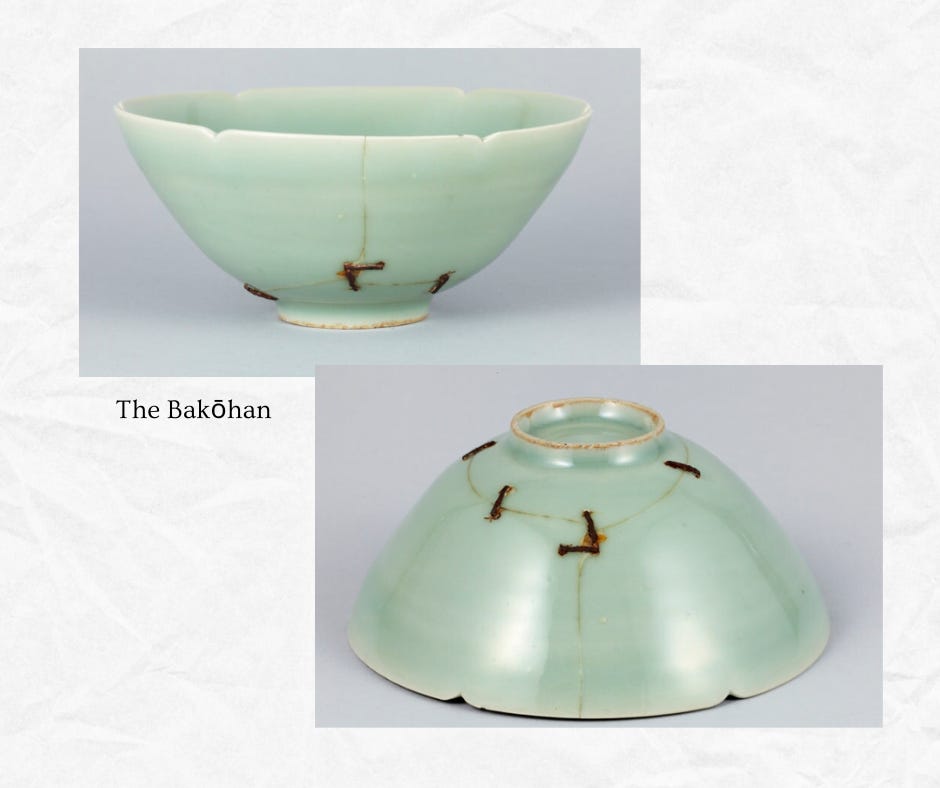
While we don’t know for sure who was the first man to mix gold powder in urushi (tree sap lacquer)1 to mend a broken pottery ware, we do know that a gorgeous celadon porcelain called the Bakōhan2 inspired subsequent repairs of bowls, urns and plates, keeping the Japanese philosophy of wabi-sabi3 in mind. A philosophy that taught one to not discard something that is broken, but to embrace it and emphasize its fragile impermanence and imperfect beauty, and which eventually gave rise to kintsugi, the art of golden joinery.
I walked into multiple pottery shops in Tokyo and Kyoto seeking my kintsugi bowl or plate. At the Japan Kanji Museum and Library in Kyoto, a young Japanese staff, who looked like she had stepped out of an Anime comic book and who had lived in Washington D.C for the first 12 years of her life, explained to me that one can’t really walk into a store and buy a kintsugi item. ‘You need to take your broken bowl or plate to a kintsugi artist and they repair it for you,’ she said. I was disappointed, and considered buying a bowl to break, but hubby dear proved unsupportive. And then I got lucky. Lucky enough to come across an obscure café with an attached kintsugi workshop on my way to a little temple famous for its moss garden. Moss, fortunately is not a trending item, so this was one of the few places in Kyoto which was not crowded. On my way back, I browsed among the spartan display at the workshop and saw a plate – all pale pinks, creams and grays woven together with thin strands of golden epoxy. My kintsugi plate.
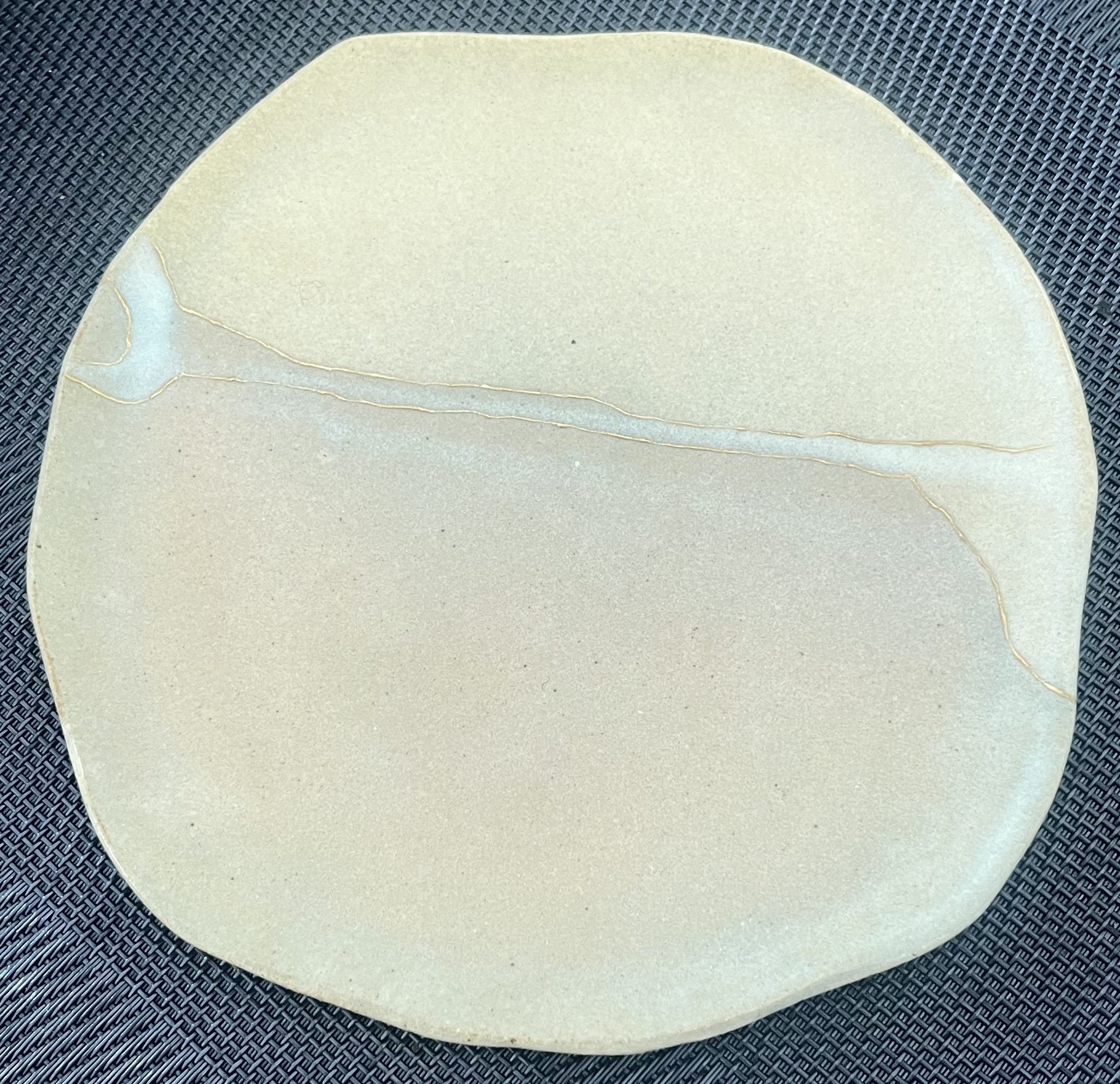
In the last few years, my love and admiration for kintsugi has increased. Maybe because like those plates and bowls that needed repair, I too am broken. I am often amazed by the fact that my heart is still beating on and doing its job, despite how badly hurt it is. I imagine veins of gold running through it, holding it together - impermanent, imperfect and badly broken, but still functional and maybe even beautiful.
Stretch that metaphor a bit, and I feel that most human relations and conditions will benefit from a touch of kintsugi. The aging parent who makes us repeat the same statement five times, the young teen who retreats behind a slammed door, a spouse whose attention is on a reel rather than you, workplace colleagues and bosses who make you question your choices. Just step back for a moment from them, look at them and at your own (broken / angry / weary) heart and pour some golden urushi into the cracks. As it flows into those cracks, highlighting our very human errors and fallibility, but also emphasizing our ability to reach out, mend fences, forgive, and get up and face each day anew despite everything, kintsugi reveals its true magic. It teaches us that the cracks, the failings, and mistakes are not a flaw but a feature… the feature that makes us human.
Arigato Gozaimaz4 for reading till the end and indulging my love for kintsugi and putting up with my metaphors :).
As a reward, here are some photographs from Japan.


Only a highly creative nation would devote so much care to sewer covers and footpaths. In fact, The Guardian has done a feature on them! Check it out here.


1In its modern iteration the urushi (tree sap lacquer) and pure gold or silver powder has been replaced by synthetic epoxies or resin combined with gold coloured powder. [Resource Credit - Wikipedia]
2Read more about the Bakōhan Saōki (record of tea-bowl with a ‘large-locust’ clamp) here.
3In traditional Japanese aesthetics, wabi-sabi centers on the acceptance of transience and imperfection. It is often described as the appreciation of beauty that is “imperfect, impermanent, and incomplete”. It is prevalent in many forms of Japanese art. [Resource Credit - Wikipedia]
I love it that Wikipedia finds it necessary to warn us to not confuse Wabi Sabi with Wasabi. My mind immediately goes off on a tangent into the world of imperfect sushis and sashimis which is an impossibility. Imperfect sushis and sashimis that is. Perfectly possible for my mind to go off on a tangent - in fact it is all it seems to do at times. Sigh!
4Arigato Gozaimaz was the only Japanese phrase that rolled off our tongues. In fact on day one, when a Japanese man accidentally brushed against my friend he turned around to apologize. But by then my friend threw out an Arigato Gozaimaz, leaving him stumped and wondering WTF!
And because this is my substack and I can geek out on kintsugi to my heart’s content, here is the absolutely gorgeous Tsukumo Nasu. The Tsukumo Nasu was painstakingly reconstructed and mended by a lacquer craftsman called Fujishige Togen. The mending is invisible from the outside, that is how skilled the kintsugi artist were!
To read about the Tsukumo Nasu and other bowls that gave rise to kintsugi head here.
"I am often amazed by the fact that my heart is still beating on and doing its job, despite how badly hurt it is. I imagine veins of gold running through it, holding it together - impermanent, imperfect and badly broken, but still functional and maybe even beautiful."
I love this. What an image, uff.
All my friends are visiting Japan with wows and I have zero FOMO. But after reading you, I want to go there and be pushed down a serendipitous lane next to a moss temple, and find something I didn't even know I'd been looking for :)
Btw, I did a kintsugi workshop in Delhi where we had to first break and then join our bowls back with acrylic gold dust and epoxy -- which I thought was a violent way to heal, heh. I'd much prefer coming across it as a nonchalant, non-performative proof of someone else's healing, like you did.
This was an excellent read, Binu, and the last paragraph was a good reminder to practice the kintsugi metaphor everyday, if possible. Thanks for writing this and the photos were amazing